 CUL-DE-SAC (1966)
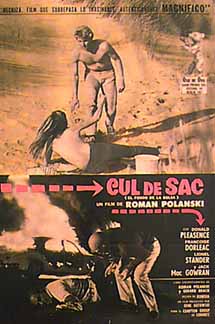
CUL-DE-SAC Argentinian poster artwork
Released: 1966
Production: GENE GUTOWSKI for Filmways
Direction: ROMAN POLANSKI
Screenplay: ROMAN POLANSKI and GERARD BRACH
Cinematography: GILBERT TAYLOR
Editing: ALASTAIR McINTYRE
Running Time: 107 minutes
Principal characters:
DONALD PLEASENCE.....George
FRANCOISE DORLEAC.....Teresa
LIONEL STANDER.....Richard
JACK MacGOWRAN.....Albert
ESSAY BY JOEL BELLMAN
Roman Polanski's Cul-de-Sac was not well received when it had its premiere in New York in the winter of 1966. As the years have passed, however, its reputation has grown until it has become a regular fixture in revival houses. It is now considered one of Polanski's classic films and is generally acknowledged as brilliant. Cul-de-Sac's early dismissal can most likely be attributed to the fact that it was only Polanski's third feature film, following Knife in the Water (1961) and Repulsion (1965), and audiences did not yet appreciate his style or orientation in filmmaking. Even those who did often find his subject matter distasteful. Because critics were put off by the unorthodox subjects and grotesque characterizations, they allowed themselves to become blind to Polanski's frequently marvelous directing technique.
Once their bizarre framework is accepted, however, Polanski's films provide a good deal of enjoyment, as well as offer some telling comments about the relationship of an individual to his environment, to his society, and to his fellow man. Polanski delights in keeping his audience on a string, a ploy used by many directors (especially Alfred Hitchcock), but seldom as effectively as in this film. The first indication of this technique is the choice of the deliberately enigmatic title, Cul-de-Sac. Since the entire film takes place on a lonely beach in Northumbria, England, with only one dwelling, a crumbling eleventh century castle, the conventional meaning of "cul-de-sac" as a dead-end street is useless. As the film develops, however, the audience gradually comes to realize that the characters are indeed on a dead-end street, but it is one of their own making. By choosing to live in such an isolated area, they have deluded themselves into thinking that they have bought their freedom from all the problems and responsibilities of the modern world. Polanski, however, does not let them off the hook so easily. Through a series of outlandishly unlucky and surrealistic coincidences, their problems compound and multiply until everyone is finally overwhelmed.
The film opens strikingly, with a hulking, sweating man in a rumpled suit pushing a small foreign car along a tide-slicked causeway on the coast. Ranting inside the car is his evidently seriously injured partner. Although the landscape looks thoroughly unfamiliar, more like a different planet than a foreign country, both men speak English, another twist from Polanski, whose previous films had been in Polish and French. What are these men doing here? How did they get to such an isolated location? Why does the injured one speak with a Cockney accent and the one pushing the car talk like an American gangster of the 1930's? Our curiosity is aroused, and Polanski keeps the game going by refusing to answer these and other questions that continue to accumulate as the film proceeds.
It eventually becomes clear, however, that there are no answers because there need be no questions. The men are there because it is absurd for them to be there; the occupants of the castle are likewise simply there, with a minimum of explanation. The point the film makes has nothing to do with motivations of the characters, their backgrounds, or any sort of conventional story logic. The theme of the film is the inability to run away from responsibility, and Polanski and his co-writer Gerard Brach devised the story to depict the theme in an odd, sometimes upsetting, but thoroughly entertaining way. Their vision has the improbability and vividness of a nightmare.
As the story continues, the character pushing the car, Richard (Lionel Stander), decides to follow the mysterious telephone poles by the road, reasoning that they will lead to a telephone. Reassuring his injured friend Albert (Jack MacGowran) that he will return with help, he sets off. Arriving at the castle, Richard is unable to rouse anyone. Dawn is breaking, and the occupants, if there are any, are still asleep, so he does the logical thing for a gangster: he breaks in. The castle itself is as absurd as its surroundings; the things most in evidence are squawking chickens and their byproducts, contributing to a refrigerator already full of rotten eggs. Famished, Richard disgustedly settles down to make an omelette and waits for somebody to appear.
The occupants of the house are a weak, ineffectual man, George (Donald Pleasence), and his incongruously beautiful wife Teresa (Francoise Dorleac). When they are first introduced, they are engaged in a sex game, with Teresa playfully tossing a woman's nightgown on George then dabbing makeup and lipstick on him. Too passive and foolish to do more than protest limply, George submits, and his humiliation is complete when he comes upon Richard, the very image of primal virility, while still dressed in this improvised costume.
Richard immediately takes charge of the situation, since George almost begs to be preempted whenever there is a decision to be made or an action to be taken. Richard's first priority is to get Albert out of the car and then to contact the mysterious Mr. Kattelbach, who employs these two mobsters, so that they can be rescued. The plans soon go awry: the tide has come in, almost swamping the car and drowning Albert; Kattelbach cannot send anyone right away to pick them up; and then, just after they get to the house, Albert dies from his gunshot wounds, evidently received on the unspecified "job" from which he and Richard have just fled.
Although the steps the characters take flow logically from one to the next, the original surreal premise allows everything to slide quickly and smoothly from mere disorientation to outright fantasy. In order to ensure that the weird couple will not call the police, Richard severs the telephone lines. Since it was a line of telephone poles that led to the castle in the first place, Richard's act of cutting the lines symbolically cuts him and the couple off from the outside world and any vestiges of reality. The entire context of the story is now exclusively the nightmare world of the castle.
There are intruders, but by the time they arrive, George, Teresa, and Richard are so bound up in their own situation, that the guests, who are old friends of George, are driven away. In a hilarious sequence, Richard is forced to masquerade as a butler, serving a disastrous luncheon to the unwanted visitors. Since the film is also about the destruction of carefully erected facades, we see that by disrupting their routine, Richard has indirectly done George and Teresa a favor---the guests are exposed as pompous, impolite bores, with a particularly nasty little child, as well as a pretty companion played by a very young Jacqueline Bisset, and the audience is delighted when George finally musters the wherewithal to kick them out.
By the film's end, everyone has been thoroughly demolished. George's wife stands revealed as an unfaithful tart, the castle and the only car are destroyed in a fire, Richard is killed in a shoot-out, and only George himself, master of his own private castle at last, is left. The conclusion is not so much downbeat as bitterly ironic; the story is, after all, not a tragedy but a black-humor lesson in the perils of worldly noninvolvement.
From MAGILL'S SURVEY OF CINEMA.
Essay © 1981 SALEM PRESS. All Rights Reserved.
Poster artwork © 1966 COMPTON-TEKLI FILM PRODUCTIONS. All Rights Reserved.
Title and logo designed by Karen Rappaport

[ FILM | CUL-DE-SAC | HOME ]